
Known for its glamorous lifestyle, Panarea is the smallest of the Aeolian Islands and a favourite destination among exclusive travellers. Yet beyond its social scene lies a wilder side, made of hiking trails, prehistoric settlements and underwater fumaroles – a side of the island that would be a shame to miss.
Panarea is well known even to those who have never visited the Aeolian Islands. Its reputation for celebrity visitors and nightlife has long overshadowed many of its other qualities, shaping the way the island is perceived. And that is a shame, because the smallest island in the archipelago is so much more than a sunset aperitivo or an evening dancing on a terrace. Not that there is anything wrong with either – quite the opposite – but the reality of Panarea goes far beyond the myth.
Staying only around San Pietro, the island’s elegant social hub, means enjoying its lively atmosphere and meeting its cosmopolitan crowd, but it also means missing the more adventurous and fascinating side of this enchanting place. Venture further and Panarea reveals a natural world that is captivating both above and below the surface. Sun-drenched trails lead to spectacular viewpoints, while secluded pebble and sandy beaches offer entirely different perspectives of the island. Then there are the traces of ancient civilisations, including the remarkably well-preserved remains of a settlement dating back thousands of years.
There really is something for everyone. And, after a day of exploring, there is always time to enjoy a more glamorous evening.
San Pietro, the harbour and the whitewashed houses
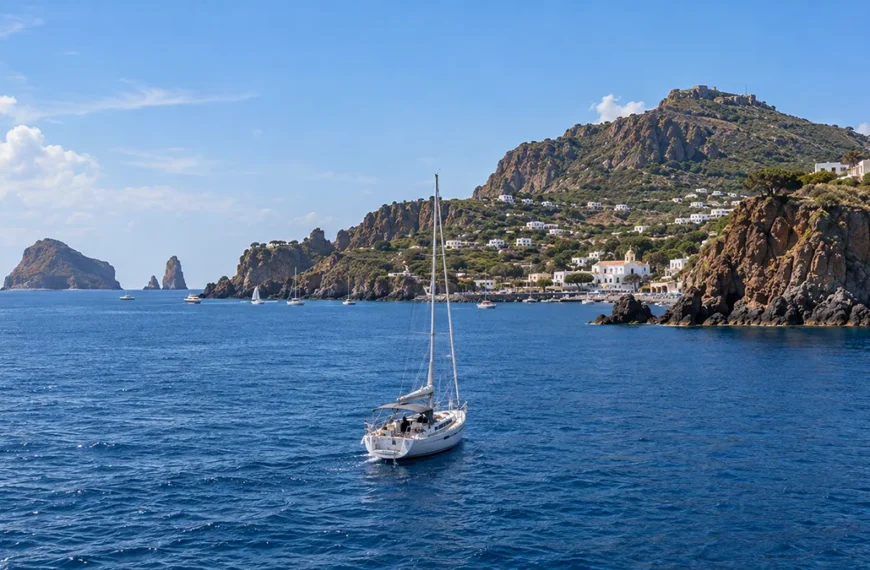
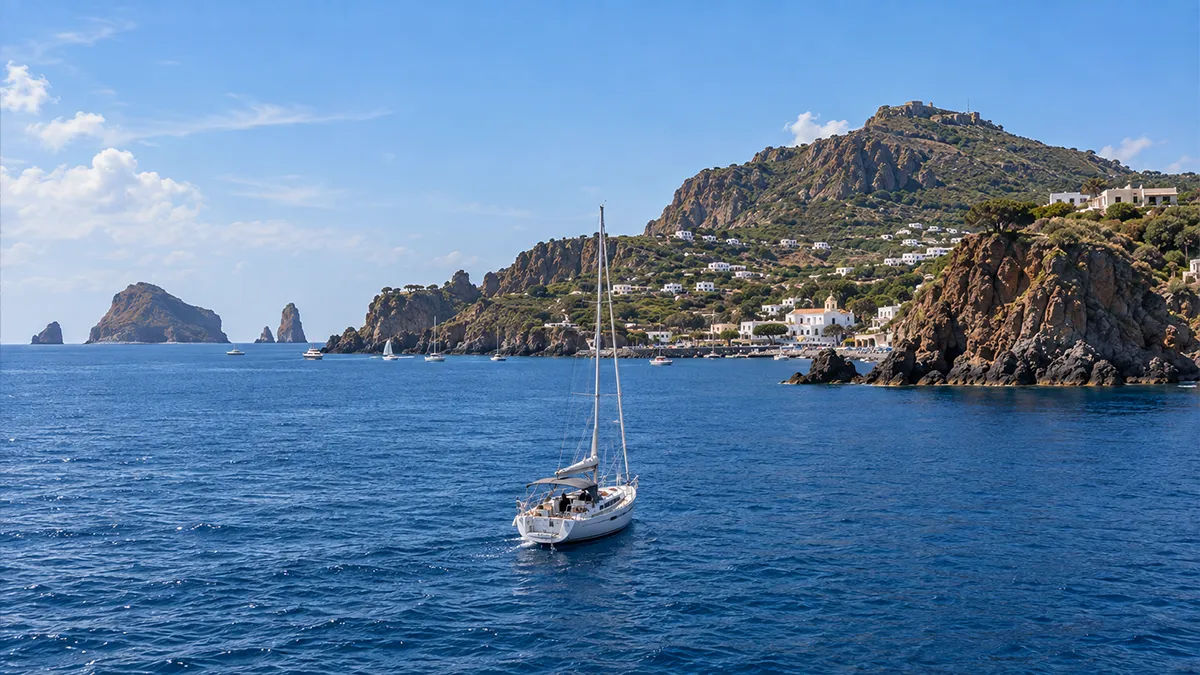
Anyone arriving in Panarea will inevitably pass through San Pietro. Not only is it the heart of the island, but it is also home to the harbour, where ferries and hydrofoils arrive and depart, and a convenient place to anchor, with mooring buoys located just offshore in front of the village.
Walking along the main street is the perfect introduction to Panarea’s lively spirit. This is where you will find the island’s main restaurants and bars, as well as grocery stores, boutiques and small shops selling local goods and souvenirs.
The narrow lanes leading inland are reserved for pedestrians and the small electric taxis that shuttle visitors between the harbour and the holiday homes, resorts and hotels. Wandering through the narrow streets, between whitewashed and pale-blue houses framed by bougainvillea, is a chance to appreciate the unmistakable character of Panarea – and to see how profoundly tourism has shaped its architecture, colours and atmosphere.
The climb to Punta del Corvo
If your idea of Panarea is about reconnecting with nature, then after exploring the village – and enjoying the inevitable granita with brioche – head towards Ditella, the small settlement north of San Pietro. From here, a trail leads to Punta del Corvo, the highest point on the island.
The goal is to reach an altitude of 421 metres. Allow around an hour and a half for the climb, and come prepared with a hat and plenty of water. The trail winds through broom, euphorbia and traditional dry-stone walls, while the sea below gradually seems to stretch further away – yet remains the undisputed protagonist of the landscape.
It is not a particularly demanding hike, but neither is it a walk to be taken lightly or barefoot. A little preparation goes a long way. During the summer months, it is best tackled in the early morning or in the hours before sunset.
The reward at the top is an extraordinary view over Basiluzzo, Lisca Bianca and Dattilo – three of the uninhabited islets scattered across the Tyrrhenian Sea just off Panarea – while, on the horizon, the perfect volcanic cone of Stromboli rises from the sea.
Cala Junco and a 3,000-year-old village
Back down in the village – and suitably refreshed at one of San Pietro’s excellent restaurants – those who still have some energy left can set out once more to discover Panarea’s natural and historical treasures.
The trail from San Pietro to Punta Milazzese takes around forty minutes, with a few ups and downs, but is accessible to most walkers. Before reaching the sea, the promontory offers a remarkable encounter that is worth the walk in itself: the remains of a Bronze Age village, with twenty-three oval huts telling a story that stretches back around 3,000 years, set against one of the most spectacular views in the Aeolian Islands.
From here, a final section of trail descends towards Cala Junco, the island’s most photographed bay. A natural pool of turquoise water, enclosed by high rocky walls that shelter it from the wind, Cala Junco is one of Panarea’s most unforgettable sights.
Perhaps this was also the natural harbour once used by the inhabitants of the ancient settlement for their boats. Once you arrive, there is little need for advice or recommendations: the sea is simply too beautiful not to experience for yourself.
Cala degli Zimmari, the island’s only sandy beach
If prehistoric ruins, crystal-clear waters and postcard-perfect views have not been enough, and you are craving somewhere sandy to lay down your beach towel, Cala degli Zimmari is the place to go.
Known as the Spiaggia Rossa, it is the only sandy beach on the entire island, where the coastline is otherwise dominated by rocks and pebbles. It can be reached along the same trail connecting San Pietro and Ditella.
What makes this beach particularly striking is the contrast between the reddish sand and the deep cobalt blue of the sea. The clear, gently sloping seabed makes it ideal both for swimming and snorkelling, and particularly appealing to families with younger children.
Exploring the islets
Back on the water, this time aboard a boat, the perspective changes completely. And so does the list of places waiting to be discovered around this remarkable island.
Panarea is surrounded by a small archipelago of rocky islets that are well worth exploring. Already visible from above during the climb to Punta del Corvo, Basiluzzo, Lisca Bianca, Dattilo, Bottaro, Lisca Nera and Spinazzola are scattered across the sea just off the coast, each with its own distinctive character.
Spinazzola, for example, is an inaccessible rocky outcrop home to a colony of dwarf palms considered unique in Europe. Beneath the waters around Bottaro, meanwhile, lies the wreck of an English merchant vessel that sank in the nineteenth century.
Exploring these waters by boat offers a completely different way of experiencing Panarea: moving from one islet to another, discovering secluded coves and seeing the Aeolian landscape from the sea.
The underwater fumaroles
Among these rocky outcrops lies another of the Aeolian Islands’ most fascinating natural phenomena.
Between Lisca Bianca and Bottaro, you can encounter the famous underwater fumaroles: bubbles of gas rising from the seabed and breaking the surface in just a few metres of water.
Snorkelling above these underwater vents, feeling the warmth rising from the rocks as you move through otherwise cool seawater, is an unforgettable experience.
The fumarolic activity has been present here for centuries, as suggested by the very name Lisca Bianca, referring to the white deposits of gypsum and sulphur built up over time by the underwater emissions.
The phenomenon became particularly notable again in the autumn of 2002. At the time, a powerful earthquake off Filicudi – just days before Stromboli entered a new eruptive phase – reactivated an entire field of underwater fumaroles in the area, with gases emerging from the seabed at temperatures of around 40°C.
Unlike the fumaroles of Vulcano, however, their origin is not thought to be directly magmatic, and scientists are still studying the source of this heat.
Another place where similar hydrothermal activity can be experienced, and one that can also be reached on foot, is Spiaggia della Calcara on the north-eastern side of the island.
Here, sulphurous vapours warm the water to almost sauna-like temperatures, while the seabed creates one of Panarea’s most distinctive and photographed colour contrasts.