
A guide to the Aeolian island of crater hikes, sulphur mud baths and sunsets best enjoyed from the deck of a boat
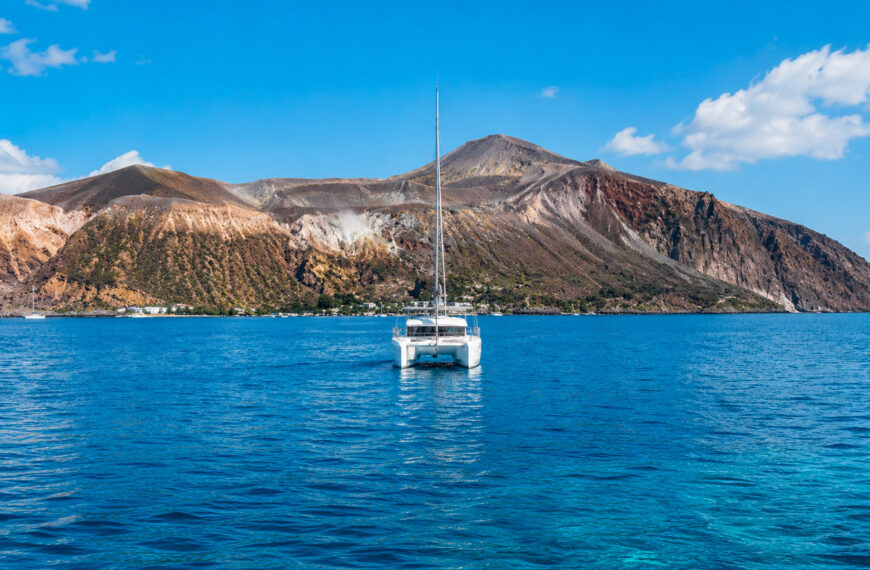
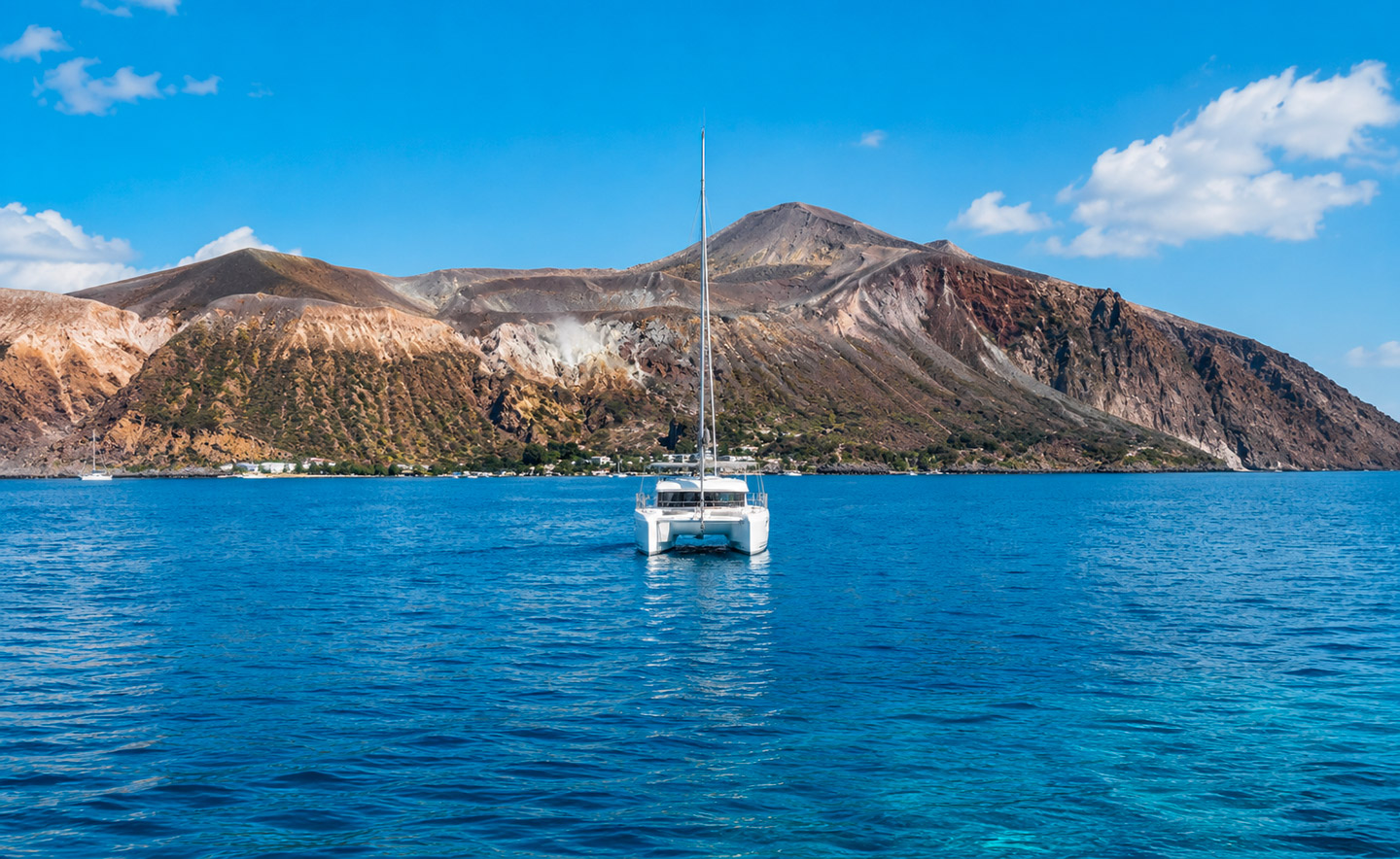
Its last eruption dates back to 1890, yet Vulcano has never truly gone quiet. The volcano that gave its name to the southernmost of the Aeolian Islands still makes its presence felt in unmistakable ways. You notice it as soon as you approach by sea: the sharp smell in the air comes from underwater sulphurous gas emissions, while the fumaroles – plumes of steam rising from the crater ridge and around the harbour – are the island’s oldest and most visible reminder that this is still a living, breathing volcanic landscape.
Vulcano is, quite literally, a hot land. The ancient Greeks first called it Therasia, “the hot land”, before renaming it Hiera, “the sacred one”, believing that the forge of Hephaestus – Vulcan to the Romans – lay hidden inside its crater.
An island best approached by sail
Arriving by sailboat is by far the most atmospheric way to encounter this rugged old lady of stone, lying 12 miles north of Sicily and separated from Lipari by the narrow stretch of water known as the Bocche di Vulcano, just 750 metres across and generally straightforward to navigate.
Landing, however, is another matter. Like the rest of the archipelago, Vulcano’s coastline is deeply indented and dramatically shaped by its volcanic origins – here more evident than anywhere else. The seabed drops steeply, and there are few sheltered spots where you can anchor without a second thought, especially when the weather is unsettled or the wind begins to rise.
If conditions turn unfavourable, the safest option is to move south and head for Milazzo, around 15 miles away on the Sicilian coast. But in settled weather, Porto di Ponente and Porto di Levante are the island’s two most reliable anchorages.
Not exactly a secret anchorage
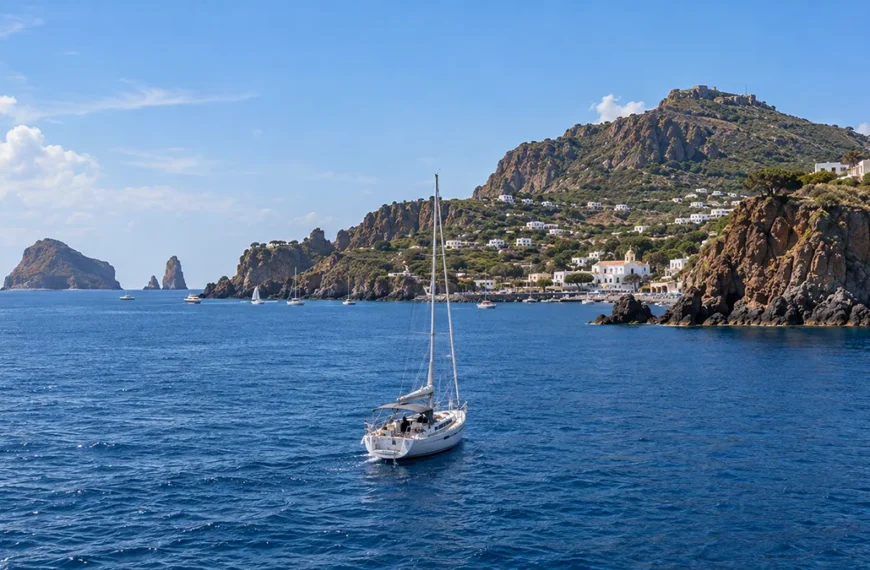
Porto di Ponente, the bay immediately southwest of Vulcanello, is the easier of the two to approach and, for that very reason, often the busier one. Don’t expect to have the island entirely to yourself. In the high season, plenty of boats drop anchor here in the late afternoon, planning to spend the night before moving on. Still, it is good company to keep: sailors drawn here by the same mix of wild scenery, thermal waters and unforgettable sunsets.
The black sands of Vulcano
Once ashore, there is one place that almost everyone is pulled towards: the famous Spiaggia delle Sabbie Nere, Vulcano’s Black Sand Beach. Here the sea looks impossibly clear against the dark volcanic shoreline, and the contrast between the black lava stones and the bright, transparent water creates one of the island’s most striking landscapes.
Just nearby lies another of Vulcano’s most iconic sights: the bubbling sulphur mud pool. Behind it, the road leads to Porto di Levante, the island’s second main anchorage. Boaters will find a quay where it is possible to moor – with prior authorisation – by anchoring on the sandy seabed, as well as floating pontoons and a nearby mooring field for those arriving by yacht.
Climbing the Gran Cratere
Whether you land at Porto di Ponente or Porto di Levante, one excursion stands above all others: the hike to the Gran Cratere, also known as the Fossa di Vulcano. It is not a walk to be underestimated, but it is well within reach for anyone with a reasonable level of fitness.
The trail begins in the village and climbs roughly 400 metres over sandy volcanic ground, dotted here and there with bright yellow broom flowers pushing through the lava rock. It takes a little over an hour to reach the summit at 386 metres, with a steady pace and a bit of stamina. The reward is extraordinary: one of the finest views in the entire Aeolian archipelago. From the crater rim, the horizon opens out across Lipari, Salina, Panarea and Stromboli, and on particularly clear days you can even make out Mount Etna smoking in the distance.
Then there is the crater itself. More than 500 metres wide, its rim is streaked with yellow sulphur deposits left by the fumaroles, a vivid reminder that Vulcano is anything but dormant in spirit.
There is, however, one important thing to keep in mind: access to the trail is regulated. An automatic traffic-light system opens or closes the path depending on gas emission levels, and in the hottest months climbing is prohibited during the middle hours of the day. The best plan is to set out at dawn or in the late afternoon, when temperatures are gentler and the crater’s lunar landscape is at its most beautiful.
Mud baths and warm waters
Back at sea level, Vulcano offers a very different kind of reward. Just beside Porto di Levante lies the island’s famous thermal mud pool, a near-obligatory ritual for anyone visiting by boat. Immersing yourself in the hot, dense, sulphur-rich mud is one of those experiences that is at once bizarre, memorable and strangely fun.
A little caution is wise – the site has been closed in the past for safety reasons – but so is a sense of humour. Smear on the grey mud, avoid the face and eyes, and enjoy the spectacle around you. One practical tip: leave watches, rings and jewellery on board, as the sulphur can blacken metal within minutes.
After the mud comes the sea. Just a few steps away are the so-called “warm waters”, where volcanic heat rises through the seabed and the sea itself seems to steam. It is the perfect natural rinse before swimming out into the cooler, open water beyond.
Exploring the island by boat
To discover Vulcano properly, having a boat makes all the difference. The coastline hides places that can only really be appreciated from the water: sea caves, hidden coves, rocky points and swimming spots invisible from land.
One of the best known is the Grotta del Cavallo, a cave of shimmering reflections and small interior pools. Along the coast towards Gelso, the scenery becomes increasingly wild, with lava cliffs, underwater caves and secluded inlets unfolding one after another. Among the most beautiful stops are the Piscine di Venere, small turquoise coves framed by volcanic rock, ideal for a swim away from the busier anchorages.
Sunset at Porto di Ponente
If you decide to spend the night at Vulcano – or simply stay until evening – there is one final ritual not to miss: sunset at Porto di Ponente. From here, with your gaze stretching out towards Filicudi, the sun sinks behind the horizon in one of the most photographed scenes in the Aeolian Islands.
The best way to experience it is also the simplest: stay on board, pour yourself a drink and watch the light change over the island from the water. At Vulcano, as so often in the Aeolian Islands, the finest view is the one seen from the sea.